Artificial Intelligence (AI) is one of the most talked-about technologies in the world today. From chatbots and virtual assistants to self-driving cars and medical research, AI is transforming the way people live and work. However, what exactly is Artificial Intelligence, and why is it becoming so important?
In this guide, we will explain AI in simple terms, how it works, its types, benefits, challenges, and its impact on our future.
What Is Artificial Intelligence?
Artificial Intelligence, commonly known as AI, is a branch of computer science that focuses on creating machines and software capable of performing tasks that normally require human intelligence.
These tasks include:
- Learning from experience
- Understanding language
- Recognizing images and sounds
- Solving problems
- Making decisions
In simple words, AI enables computers to think and act in ways that resemble human intelligence.
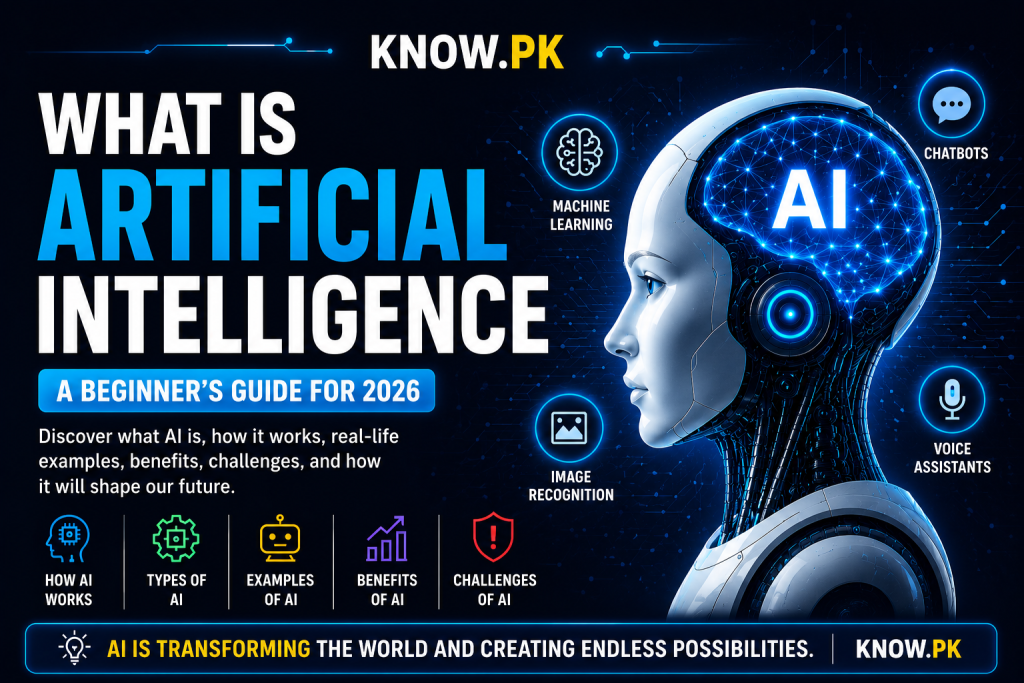
How Does Artificial Intelligence Work?
AI works by processing large amounts of data and identifying patterns within that data. Using algorithms and machine learning models, AI systems learn from examples and improve their performance over time.
The basic process includes:
- Collecting data
- Analyzing data
- Identifying patterns
- Making predictions or decisions
- Learning from feedback
For example, an AI-powered email system can learn which emails are spam by analyzing thousands of examples.
Types of Artificial Intelligence
1. Narrow AI
Narrow AI is designed to perform a specific task. Most AI systems used today fall into this category.
Examples include:
- Voice assistants
- Recommendation systems
- Chatbots
- Navigation apps
2. General AI
General AI refers to machines that can perform any intellectual task that a human can do. This type of AI remains largely theoretical and has not yet been achieved.
3. Super AI
Super AI is a hypothetical future form of AI that would surpass human intelligence in every aspect. It currently exists only in theory and science fiction.
Common Examples of AI in Daily Life
Many people use AI every day without realizing it.
Examples include:
- Virtual Assistants
Digital assistants can answer questions, set reminders, and perform tasks using voice commands.
- Social Media Algorithms
Platforms use AI to recommend content based on user interests and behavior.
- Online Shopping
E-commerce websites use AI to suggest products that customers may want to purchase.
- Navigation Apps
Map applications use AI to predict traffic conditions and suggest the fastest routes.
- Streaming Services
Entertainment platforms recommend movies and TV shows based on viewing history.
- Benefits of Artificial Intelligence
AI offers numerous advantages across different industries.
- Increased Efficiency
AI can perform repetitive tasks quickly and accurately.
- Better Decision-Making
Businesses use AI to analyze large amounts of data and make informed decisions.
- Improved Healthcare
AI helps doctors detect diseases, analyze medical images, and improve patient care.
- Enhanced Customer Service
Chatbots provide instant support to customers around the clock.
- Automation
AI automates routine tasks, allowing people to focus on work that is more important.
- Challenges and Risks of AI
Despite its benefits, AI also presents certain challenges.
- Job Displacement
Automation may reduce the demand for some traditional jobs.
- Privacy Concerns
AI systems often rely on large amounts of personal data.
- Bias and Fairness
AI models can sometimes produce biased results if trained on biased data.
- Security Risks
Cyber criminals may misuse AI for malicious purposes.
AI in Different Industries
- Healthcare
AI assists in disease diagnosis, drug discovery, and patient monitoring.
- Education
AI-powered learning platforms provide personalized educational experiences.
- Finance
Banks use AI for fraud detection, risk assessment, and customer service.
- Transportation
AI contributes to autonomous vehicles and traffic management systems.
- Agriculture
Farmers use AI to monitor crops and improve productivity.
The Future of Artificial Intelligence
The future of AI looks promising. Experts believe AI will continue to transform industries, create new opportunities, and improve efficiency across various sectors.
Potential future developments include:
| More advanced virtual assistants |
| Improved healthcare technologies |
| Smarter cities |
| Enhanced education systems |
| Advanced robotics |
As AI technology evolves, it will likely become an even bigger part of everyday life.
Frequently Asked Questions (FAQs)
Q1.What is AI in simple words?
AI is technology that allows computers and machines to perform tasks that usually require human intelligence.
Q2.Is AI dangerous?
AI itself is not dangerous, but it can be misused if not developed and regulated responsibly.
Q3.Where is AI used today?
AI is used in healthcare, education, transportation, finance, social media, online shopping, and many other industries.
Q4.Will AI replace human jobs?
AI may automate certain tasks, but it is also expected to create new jobs and opportunities.
Artificial Intelligence Changing the World
Artificial Intelligence is changing the world at an incredible pace. From helping businesses make better decisions to improving healthcare and education, AI has become an essential part of modern life. While challenges exist, the potential benefits of AI are enormous. Understanding how AI works can help individuals and businesses prepare for a future where intelligent technology plays a larger role in everyday activities.